[eBook] One size does not fit all: A guide to multitenant authorization

Fixed roles break under enterprise scale

When a 30,000-person organization signs up for a SaaS product, the "Admin, Editor, Viewer" model becomes a cage. Role explosion, endless support tickets, and blocked productivity follow. One size does not fit all.

Every enterprise customer has unique organizational structures, complex hierarchies, and distributed teams. The "North America Marketing Content Editor" needs different access than the "EMEA Financial Reviewer." Matrix reporting, regional compliance requirements, and specialized functions demand granular, contextual permissions that static roles simply can't provide.

This ebook reveals how leading SaaS companies implement dynamic multitenant authorization that scales from 10 users to 30,000 - without role explosion.

What's inside the ebook

Drawing from enterprise implementations, multitenant architecture patterns, and authorization best practices, we cover:

  • Diagnosing the problem

    Recognize the warning signs of authorization breaking under scale, before role explosion cripples productivity and blocks deals.

  • Implementing the solution

    Policy-as-code fundamentals, delegated administration patterns, and multitenant architecture that adapts to each customer's reality.

  • Achieving enterprise scale

    Proven patterns for tenant isolation, performance at scale, and audit ready authorization that satisfies compliance requirements.

Frame 2147215472-2

Created for IAM, software architecture and engineering teams

Strategic guidance on delegated authorization

Architecture patterns for multitenant SaaS & enterprise deployments

50+ pages of in depth    content

Eliminate role explosion, endless support tickets, and blocked enterprise deals

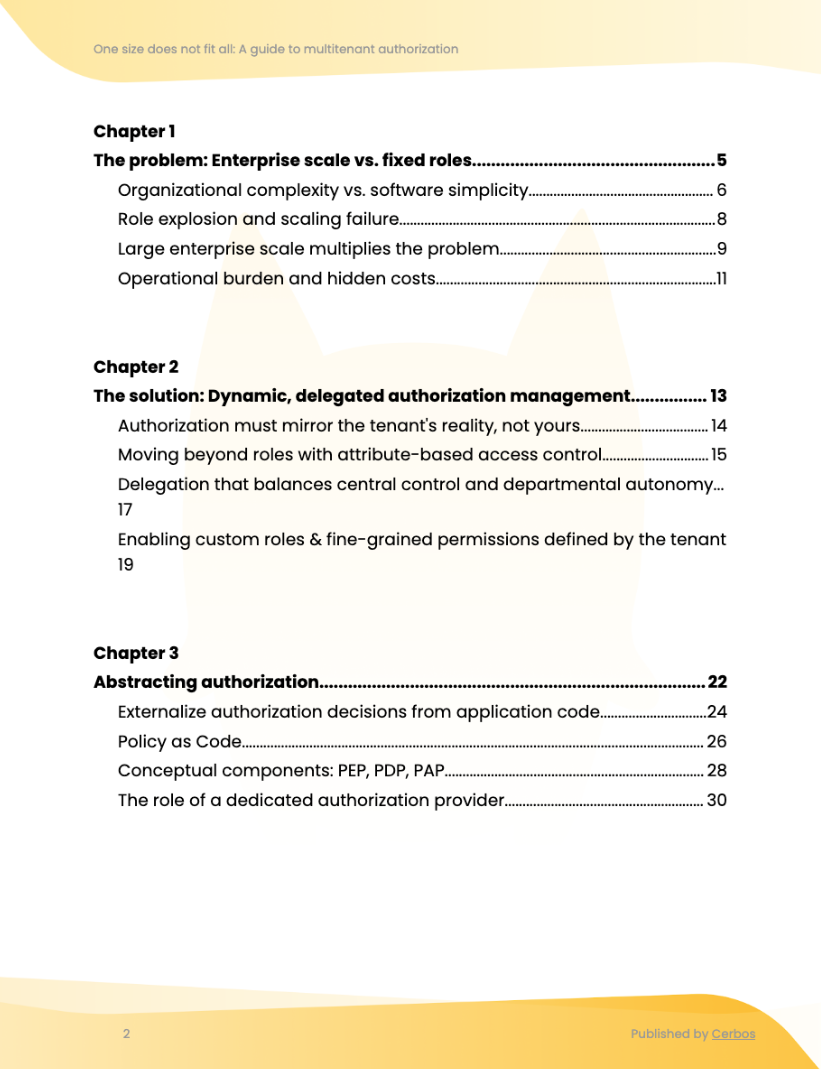
Why fixed roles break in enterprise environments

Why fixed roles break in enterprise environments

Discover the fundamental mismatch between simple authorization models and organizational reality. Learn how the traditional "Admin, Editor, Viewer" model breaks down when scaling to hundreds of tenants, each with thousands of users, what role explosion actually looks like, and the hidden costs that rigid authorization creates: support burden, security gaps, lost deals.

Topics covered: Role based access control limitations, privilege creep, least privilege principle violations, matrix reporting structures, multitenancy patterns.

Authorization that mirrors each tenant's reality

Move beyond fixed roles to dynamic, tenant-controlled authorization. Understand attribute based access control, how to enable customers to define their own roles, and delegation patterns that balance central control with departmental autonomy across thousands of unique organizational structures.

Topics covered: Attribute based access control, dynamic policy evaluation, tenant scoping, delegated administration, policy inheritance.

Authorization that mirrors each tenant's reality
Externalizing authorization from application code

Externalizing authorization from application code

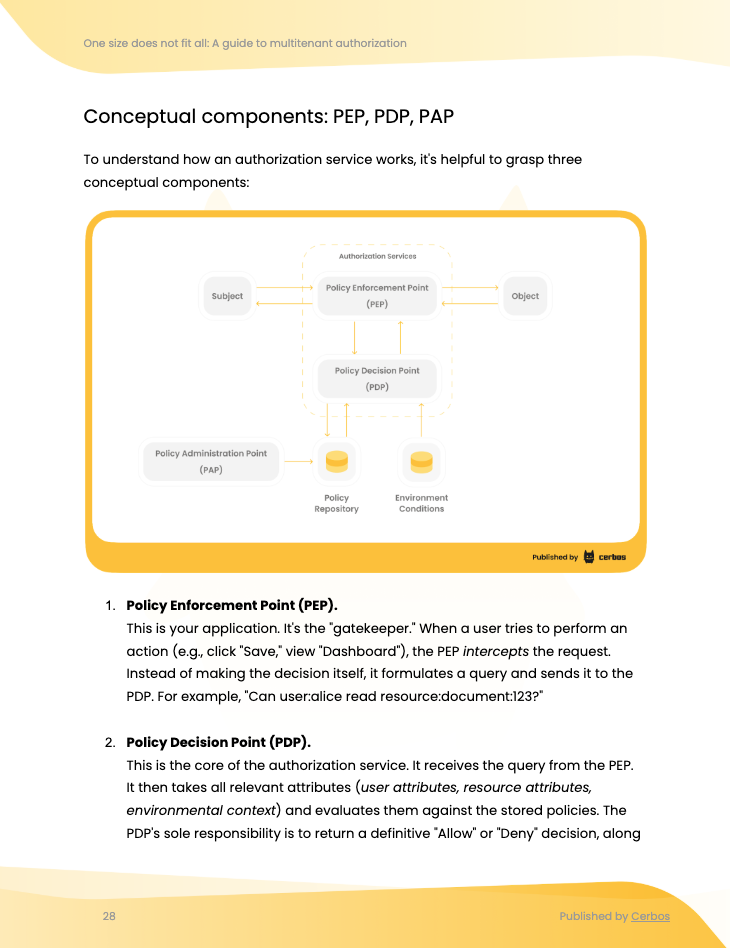
Learn the architectural patterns that separate authorization decisions from business logic. Explore Policy as Code principles, the PEP/PDP/PAP pattern that powers modern authorization, and why dedicated authorization infrastructure beats scattered permission checks in application code.

Topics covered: PEP/PDP/PAP components, Policy as Code, policy versioning, decision logging, API-driven authorization.

Real world multitenant authorization architecture

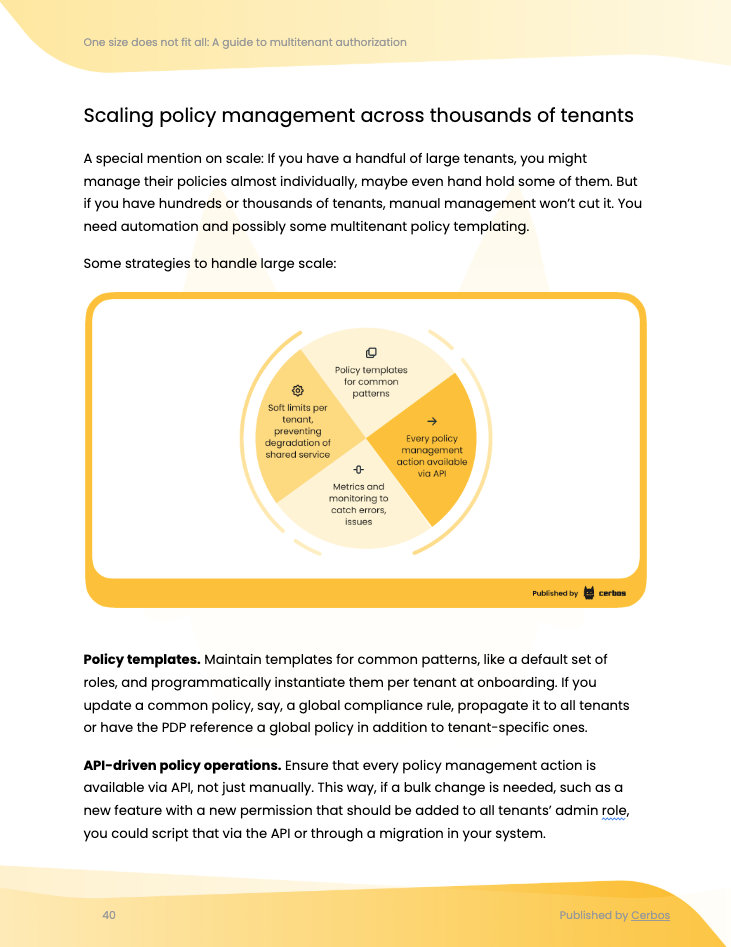
Examine proven implementation approaches for both multitenant SaaS (one instance, many customers) and enterprise deployments (customer-specific instances). See how to implement tenant isolation, empower tenant admins, and scale policy management across thousands of customers without operational chaos.

Topics covered: Tenant isolation, policy namespacing, scoped policies, SSO integration, identity federation, policy bundling, horizontal scaling, policy store architecture.

Real world multitenant authorization architecture
Measurable benefits across the organization

Measurable benefits across the organization

Understand the tangible benefits of dynamic multitenant authorization. From customer satisfaction and faster enterprise sales to developer velocity and compliance readiness. See how flexible authorization delivers measurable business value while eliminating the support burden of rigid role systems.

Topics covered: Zero Trust architecture, audit trails, SOC2 compliance, GDPR requirements, decision traceability, policy testing, performance SLAs, authorization latency.

Build for the real world

Authorization is infrastructure. By externalizing and making it tenant-configurable, teams gain agility, scalability, and customer alignment. See how Cerbos enables the patterns discussed throughout this guide, making fine grained, delegated access control practical for SaaS and enterprise software.

Topics covered: Authorization service architecture, policy deployment workflows, CI/CD integration, migration strategies, API patterns.

Build for the real world
Emre

About the author

Emre Baran, co-founder of Cerbos, ex-Googler, entrepreneur & software executive with 20+ years of experience.

What’s inside the ebook

TOC 1
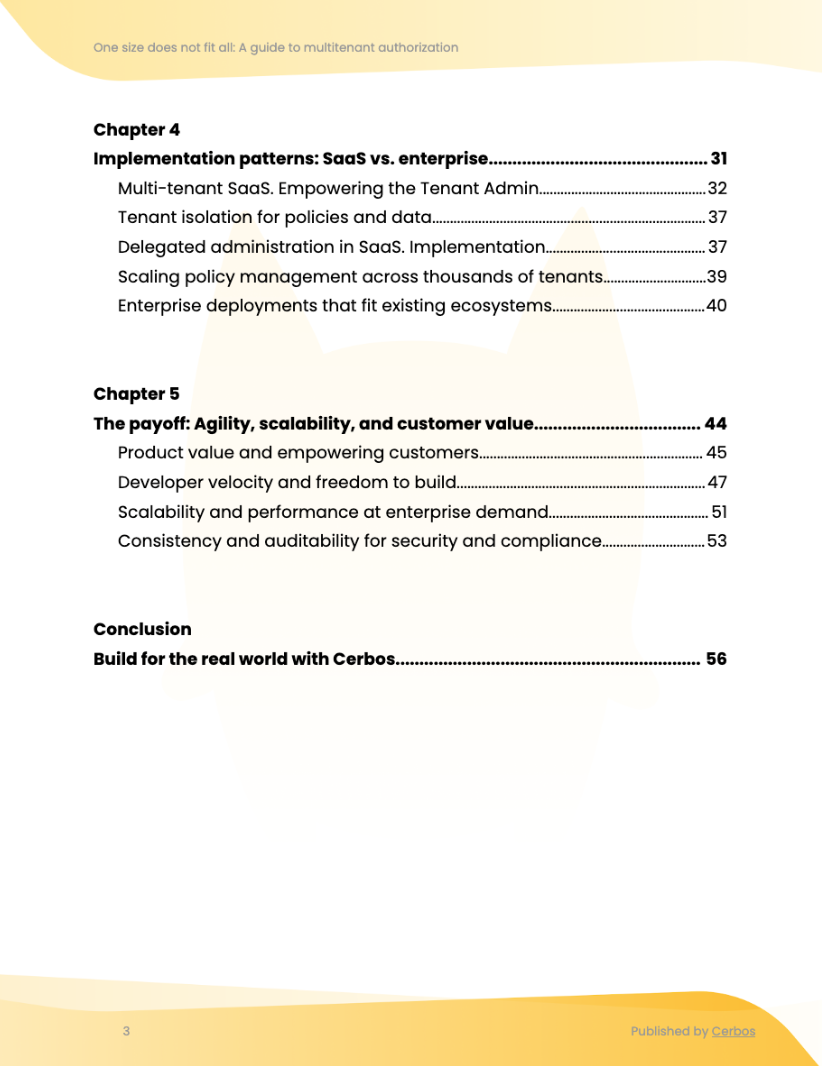
TOC 2
Cerbos logotype

Authorization for enterprise software and AI

Enforce fine grained, contextual, and continuous authorization in every layer of the software you build. Secure applications, APIs, workloads, and AI agents.

Discover other ebooks on IAM, security and software architecture

How to adopt externalized authorization

How to adopt externalized authorization

Securing ai agents and NHIs

Securing AI agents and NHIs in enterprises

 Zero Trust for AI: Securing MCP Servers

Zero Trust for AI: Securing MCP Servers